Customer Story Hub
How North Carolina improved officer safety with TASER 10, data, and training
:format(webp))
At a Glance
Organization: North Carolina Department of Adult Correction (NCDAC)
Facilities: 54 correctional institutions statewide
Community Supervision Staff: More than 2,000 probation and parole officers
Deployment: More than 5,000 TASER energy weapons deployed statewide, including every certified probation and parole officer
Key Solutions: TASER 10, Axon’s TREND program, Axon VR Training, Axon Body 4
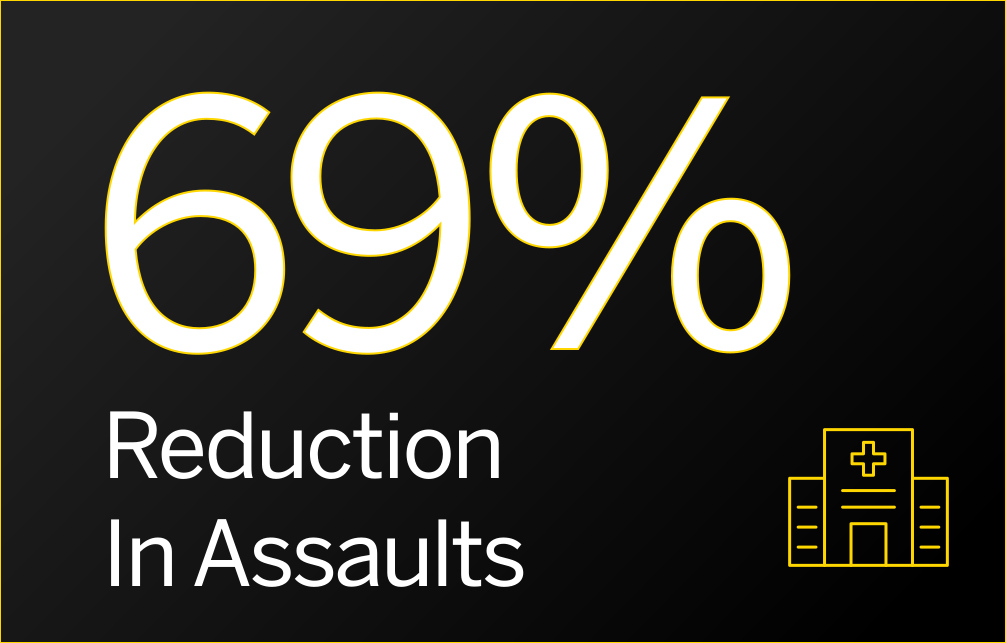
69% reduction in assaults
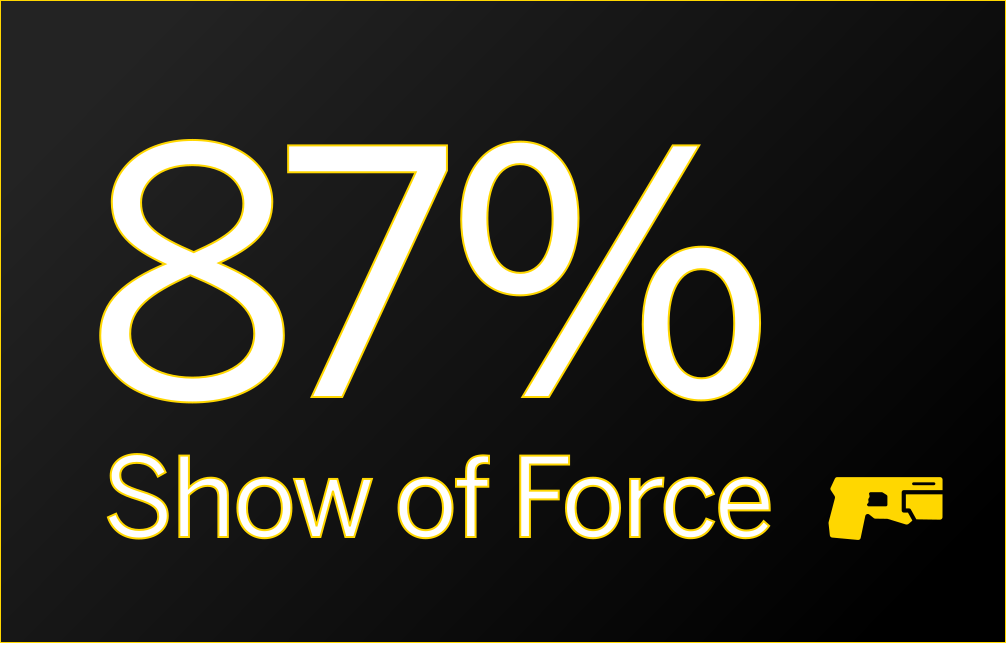
87% resolved through show of force
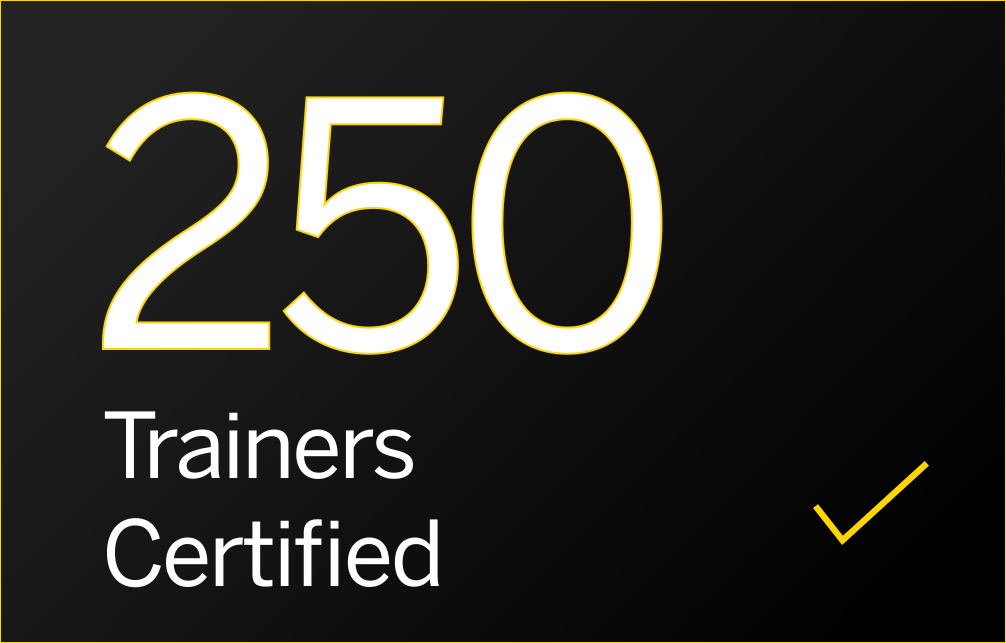
250 trainers certified
Introduction: protecting those who protect others
Every day, correctional officers and community supervision personnel walk into unpredictable situations. Whether responding to violence inside a prison housing unit or conducting a field visit as a probation officer, their job requires maintaining control in environments where tensions can escalate quickly.
For the North Carolina Department of Adult Correction (NCDAC), protecting those officers has become an increasingly urgent priority. "We're seeing a more aggressive offender population," said Ken Smith, chief of emergency preparedness for NCDAC.
Over the past decade, rising levels of aggression and violence forced the department to reexamine how it equips staff to safely resolve confrontations. Traditional force options often required officers to move closer to danger, increasing the likelihood of injury. Smith believed there had to be a better way.
My goal has always been: What can I do to make it better for the staff? Give them a tool to make them safer and let them go home every day without getting a scratch on them, if we can.
That philosophy ultimately led NCDAC to one of the largest TASER deployments in corrections: a statewide rollout of 5,000 TASER 10 energy weapons designed to create distance, reduce injuries, and improve outcomes for everyone involved.
The Challenge: rising violence, limited options
For many correctional officers, responding to violence historically meant relying on OC spray, batons, or physical restraint.
In prison environments where firearms are prohibited, officers often had few alternatives beyond close-contact force options. "We were looking for a tool more effective than general OC spray," Smith said. "Sometimes, you need more than one option."
As offender behavior became increasingly aggressive, department leaders recognized a growing gap between the risks officers faced and the tools available to address them. The challenge extended beyond prisons. Probation and parole officers regularly encountered unpredictable situations in homes, communities, and field settings where maintaining distance could mean the difference between a safe resolution and a serious injury.
NCDAC needed a force option that could:
Increase officer safety
Reduce the need for physical confrontation
Improve compliance during volatile incidents
Create safer outcomes for both staff and offenders
Scale across one of the nation's largest corrections systems
The Solution: TASER 10 and Beyond
 NCDAC first began exploring Axon energy weapons in 2018 through a pilot program involving TASER X2 devices at twelve close-custody prisons. The results were encouraging, and as confidence in the technology grew, the department expanded its deployment. In 2024, NCDAC made the decision to adopt TASER 10 statewide.
Rolling out TASER 10 across North Carolina's corrections system required a massive training and logistics effort.
The department certified approximately 250 instructors and conducted training at more than 50 locations throughout the state.
"There is no one department, one training location ... it is massive," Smith said. When the department discovered that initial equipment forecasts would not fully meet deployment needs, Axon quickly adjusted its support plan.
"Axon fixed it, they ate the cost, and they made it right," Smith said. "That was a true partnership."
Today, more than 5,000 devices are deployed across the department, including issuance to every certified probation and parole officer and staff at 35 correctional institutions. The impact was immediate.
Beyond TASER: Cameras and VR
In tandem with TASER 10, NCDAC launched a pilot of Axon’s body-worn cameras (BWCs) for probation and parole officers. These officers are frequently in the field, doing home visits and more. Having a recorded record of those meetings proved essential.
“Our probation and parole officers loved it. I thought the feedback would be the opposite, but they absolutely loved it,” Smith said. “They often get accused of doing wrong things, but the video supported staff when complaints were made.”
BWC footage also reduced the time needed to investigate false misconduct allegations. “Now we can say, ‘Just look at the video,’” he said.
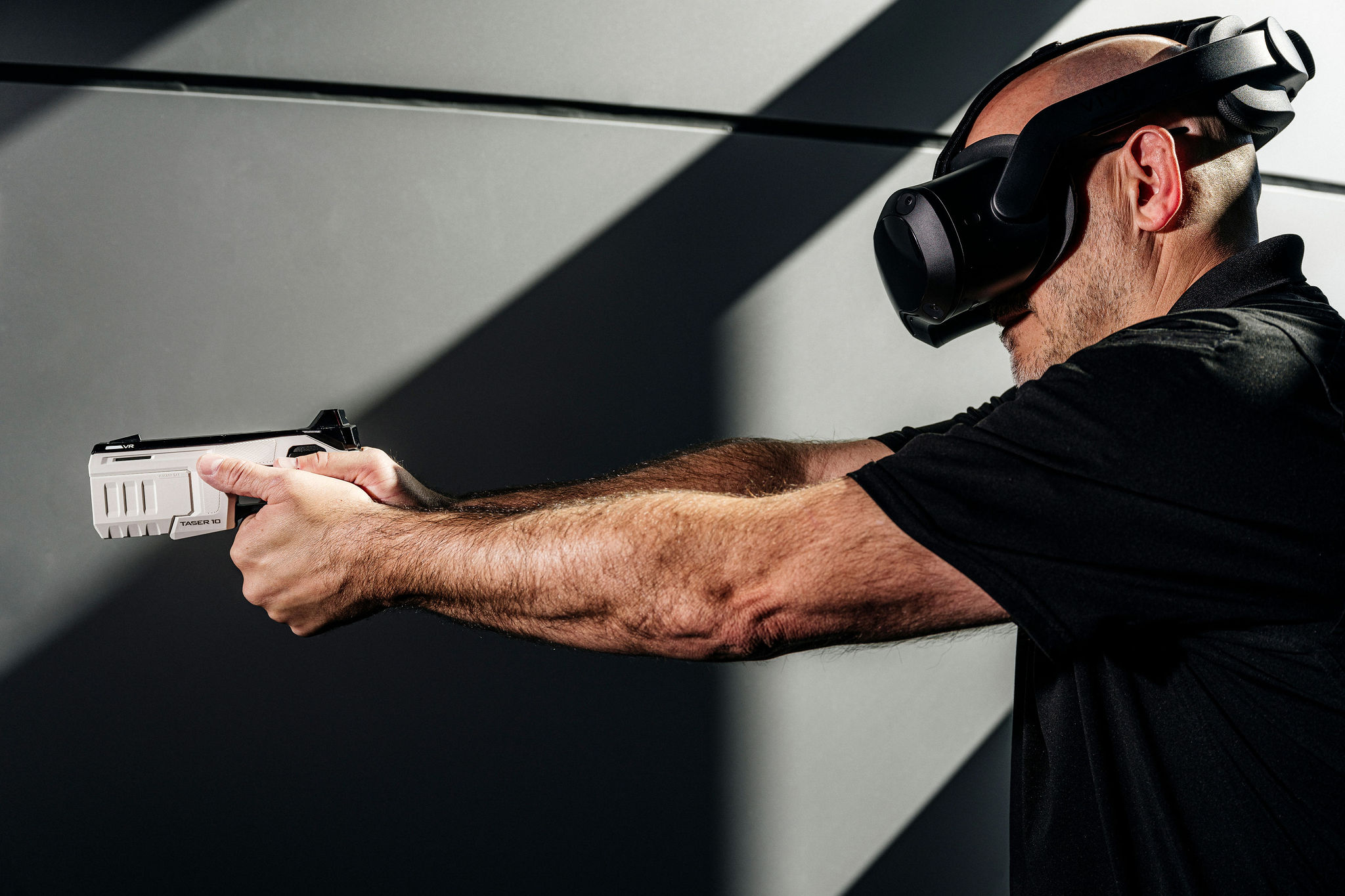
Axon VR Training also gained traction with field staff. “Repetitions on the TASER and its functions make staff feel more comfortable,” Smith said. “It improves accuracy. It gives tactical advantages.”
Though scheduling VR sessions for prison staff remains a challenge, Smith sees long-term value.
Building out the full ecosystem
NCDAC plans to continue expanding their investment in officer safety. Smith explains, “Our leadership did not want stop at the TASER 10. They want to do everything they can for our staff and their safety.”
The agency has made a major commitment to rolling out additional body-worn cameras and is taking steps to integrate Fusus, Dedrone, Skydio Drones, Outpost cameras, and more. They plan to use Outpost to check the license plates of all visitors, identifying vehicles who visit multiple prisons or who may have a criminal record.
Dedrone will monitor their facilities for drones that attempt to drop contraband into the facility. They can identify the pilot’s location and intervene if needed, and track the total number of drones attempting to enter the area.
Similar to their TASER 10 and Axon body-worn camera rollouts, the NCDAC is testing these new solutions at three facilities with the goal of proving the value before rolling them out across the state. For agency leadership, these investments are part of a larger strategy to build an integrated technology ecosystem that enhances safety, awareness, and efficiency across corrections operations.
The safety and security of our employees is paramount, whether they are inside a prison or out in the community. Our strategic deployment of additional Axon technologies will help us keep our staff aware, safe and secure and help them work more efficiently.
How TASER 10 changed incident response
TASER 10 introduced capabilities that gave officers more flexibility and confidence during critical incidents. Unlike earlier generations of energy weapons, TASER 10 allows officers multiple opportunities to achieve effective probe placement without immediately exhausting their options.
"If you miss, it's okay—keep firing until you get the subject under control," Smith said.
The increased capacity helps officers maintain distance and control in rapidly evolving situations while reducing pressure during high-stress encounters. One incident particularly reinforced the importance of the technology.
A probation officer became trapped between a vehicle door and the driver's seat during an encounter. A TASER 10 deployment allowed officers to regain control of the situation and prevent further injury. "Without that tool, deadly force may have come into question," Smith said.
In many cases, the presence of the device alone changed behavior before force was ever required. For NCDAC, that deterrent effect became one of the most important outcomes of the program.
Our show of force numbers with no injuries are far greater than the use of forces with probes actually being deployed. That's a win.
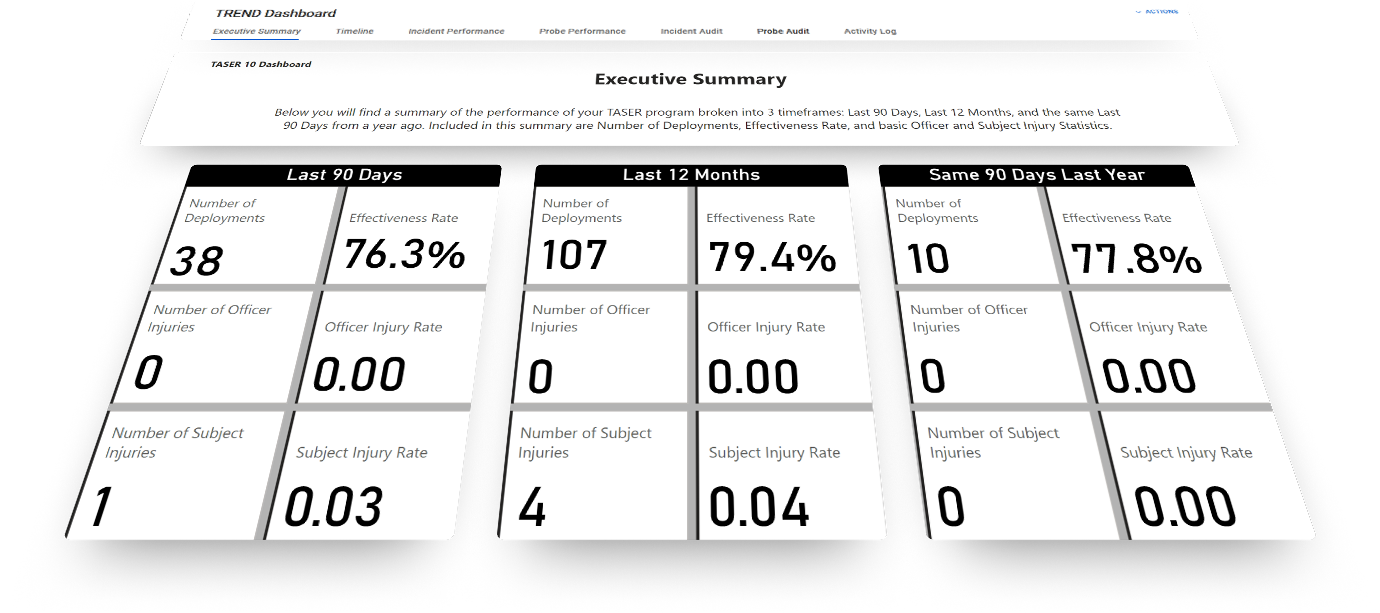
Using Axon's TREND platform, leaders gained visibility into both deployments and deterrence outcomes, helping quantify the value of the program beyond traditional use-of-force reporting.
 The Impact: fewer injuries, safer officers
Force avoidance through compliance
The department's community supervision data demonstrates just how powerful that deterrent effect can be.
Across 2023 and 2024, NCDAC recorded 53 TASER-related incidents involving probation and parole officers. In 46 of those encounters, compliance was achieved through a TASER 10 Show of Force alone, resulting in an 87% force avoidance rate. Only seven incidents required an actual TASER 10 deployment.
These numbers reinforced a critical principle: the most successful use-of-force incident is often the one that never requires force at all. Using the TASER 10 as a show-of-force meant that subjects complied without physical confrontation, hands-on force, OC spray, or CRDT techniques.
“We had offenders who, when a sergeant came around with the TASER 10 on the belt, would yell out, ‘Sarge on the block!’ or ‘Lightning!’” Smith recalled. “That meant TASER, and fights would stop right then.”
Measurable reductions in staff injuries
NCDAC's broader focus on officer safety has coincided with significant reductions in staff injuries across the correctional system. Department data shows that assaults on prison staff resulting in serious bodily injury or physical injury declined from 340 incidents in 2019 to 107 incidents in 2023—a 69% reduction.
While multiple factors contribute to officer safety outcomes, department leaders have invested heavily in training, technology, and tools designed to create distance, reduce physical confrontations, and improve compliance before force becomes necessary.
Combined with the department's 86.8% force avoidance rate in community supervision, the data reflects a strategy focused preventing violence, rather than simply responding to it.
For Smith, the true measure of success is found in the experiences of officers who return home safely after every shift. One story in particular stands out.
A correctional captain who had previously been assaulted by an offender suffered a serious head injury that required staples. Before TASER deployment, he felt as though officers had to physically fight their way through incidents every day.
"Within a week of them receiving the TASER 10s, that correctional captain called me and told me that it was the best move DAC had ever made," Smith said. The feedback wasn't isolated.
"Without a doubt, staff at the boots-on-the-ground level were super appreciative," Smith said. "The initial results showed fewer assaults on staff and quicker responses to orders when approaching offender-on-offender violence."
For NCDAC, deploying the TASER 10 meant better tools, greater confidence, and safer options for their staff when facing some of the most challenging situations in public safety.
Conclusion: safety through continuous improvement
As correctional environments continue to evolve, NCDAC remains focused on finding new ways to protect its workforce.
The statewide deployment of TASER 10 has helped the department create distance from danger, reduce injuries, and improve outcomes during critical incidents. More importantly, the results suggest that when officers are equipped with effective tools and training, force can often be avoided altogether.
Through a combination of technology, training, and a relentless focus on officer safety, NCDAC has demonstrated that better outcomes are possible, not just for staff, but for everyone involved.
Investing in the TASER 10 program was a major step toward strengthening safety for NCDAC staff. However, the agency remains committed to further increasing safety for both staff and offenders through continued investments in security-related equipment and programs.
Within the past year, NCDAC has deployed more than 2,200 body-worn cameras to all certified Probation and Parole Officers and selected prison employees assigned to offender transports and other high-risk assignments, including K9 Officers and Special Operations Task Force members.
The agency has also expanded its use of Fusus within three of its largest prison facilities, enabling drone detection, AI integration with internal camera systems, enhanced perimeter and outside security, and faster notification and response through the Axon Vision platform.
In addition, NCDAC has incorporated virtual reality into its TASER 10 and firearms training, helping staff build greater familiarity and proficiency with these critical tools.
Through a combination of technology, training, and a relentless focus on officer safety, NCDAC has demonstrated that better outcomes are possible, not just for staff, but for everyone involved.
The NCDAC is not going to stop. We are going to keep looking for ways that technology, whether it’s Axon or someone else, can solve problems and enhance officer safety. That is our ultimate goal.
:format(webp))